There is a moment every producer knows. You are listening to a record, maybe something you have loved for years, and there is a sound in there that just does something. Something specific. It is not "a synth" or "a pad". It is that sound. You know exactly what I mean.
The question is always: how close can you actually get?
That question is what pushed me down the wavetable rabbit hole. And the answer, it turns out, starts with understanding what a wavetable actually is, not just as a concept, but as a practical tool for capturing the character of real hardware.
What Is a Wavetable, Really?
Let me start from the beginning, because this is where most explanations lose people.
You know what an oscillator is. At its most basic, it generates a repeating shape, a signal that tells a speaker cone how to move back and forth. A sine wave is a smooth S-curve. A sawtooth is a series of sharp rises and drops. A square wave is an abrupt on-off cycle. These shapes are the alphabet of synthesis.
A wavetable does something a little different. Instead of using one of those fixed geometric shapes, it uses the shape of an actual recorded sound as its oscillator. You take a snippet of audio, ideally a single repeating cycle of a waveform, zoom all the way in, find the point where that shape completes one full journey from zero through positive and negative and back to zero, and you use that as your oscillator.
Think about it like this: you've seen those old films where someone puts a microphone in front of an oscilloscope and you can see the waveform dancing on the screen. That specific shape, that curve, that is the fingerprint of that sound. Every instrument, every synthesiser, every piece of hardware has its own unique oscilloscope signature. A wavetable is, in essence, a way of capturing that fingerprint and transplanting it into a modern synthesiser.
What makes this different from a sample? Scale and intent. A sample is a recording, a complete performance, a note held, a sound in time. A wavetable is a single cycle, a snapshot of the waveform's shape, looped to create an oscillating tone. It is not the recording. It is the blueprint underneath the recording.
The CZ101 and the Sound of a Generation
Right. I need to talk about the Casio CZ101.

The CZ101 was not, by anyone's standards, an expensive or prestigious piece of kit. It came out in the mid-1980s as a budget consumer synthesiser, phase distortion synthesis in a small, plasticky body that you could actually afford if you were a bedroom producer in the UK at the end of the 1980s. And that affordability is everything.
Because when certain sounds ended up in front of certain people not by design, but by budget, the results were extraordinary. Producers reached for the CZ101's organ preset not because it was the technically correct choice, but because it was there. And from those constraints came a sound that defined an era.
That organ preset, specifically around preset six, though I'd be lying if I told you I remember exactly, became the rave organ. If you grew up going to raves in the UK or listening to the pirate stations, you know this sound. It is all over the early 1990s: Two Bad Mice, Pizzaman, tracks that were rattling sound systems from Manchester to London and getting played on the illegal FM stations that most people outside the UK might not have had access to.
For those not familiar, pirate radio was how rave music actually spread in the UK before mainstream stations would touch it, bedroom broadcasters transmitting from tower blocks, and producers listening.
That sound carried a whole cultural moment. And it is still being used today.
How Wavetable Extraction Captures Real Hardware Character
So how do you actually get a hardware synth's character into Serum 2 as a wavetable?
It starts with recording. You need the actual hardware, in this case, a working CZ101, captured cleanly through a proper signal chain. We run ours through Neve 1073 DPX preamps, which matters more than people realise. The quality of that initial capture determines the ceiling of what you can extract.
Then comes the work. I use iZotope RX 11 for this stage. It is a professional audio editor that lets you zoom extraordinarily deep into a waveform.

The CZ101 organ recording in iZotope, zoomed out. At this view you can see the repeating patterns of the waveform. The dashed markers indicate the selection region.
What you are looking for is the zero-crossing point, where the waveform completes one full oscillation and returns to centre. That is your cycle. You zoom in, identify it, and isolate it.

Zoomed in on a single cycle. At this resolution you can see the distinctive shape of the CZ101's phase distortion synthesis, this irregular, harmonically complex curve is what you are trying to capture.
Here is where people make the first mistake, and I know because I made it myself: you definitely do not drag the full sample file straight into Serum.

This is what happens when you drag a full audio file directly into Serum 2. It will analyse the entire file and create frames from everything. including the attack, the noise, the artefacts. The result is usually a mess. Do not do this.
The CZ101 uses dual oscillators running through phase distortion, and they interact with each other. Over time, as the oscillators drift slightly in relation to each other, the sound evolves, a kind of gentle movement that gives it life. To capture that, you need multiple cycles from different points in the recording.
For the CZ101 organ wavetable, I ended up using around 35 frames. You stack those cycles chronologically and build them into a single audio file, a few seconds long at most. When you load that into Serum 2 and scan the wavetable position, you are scanning across time, catching different moments in the evolution of the sound.

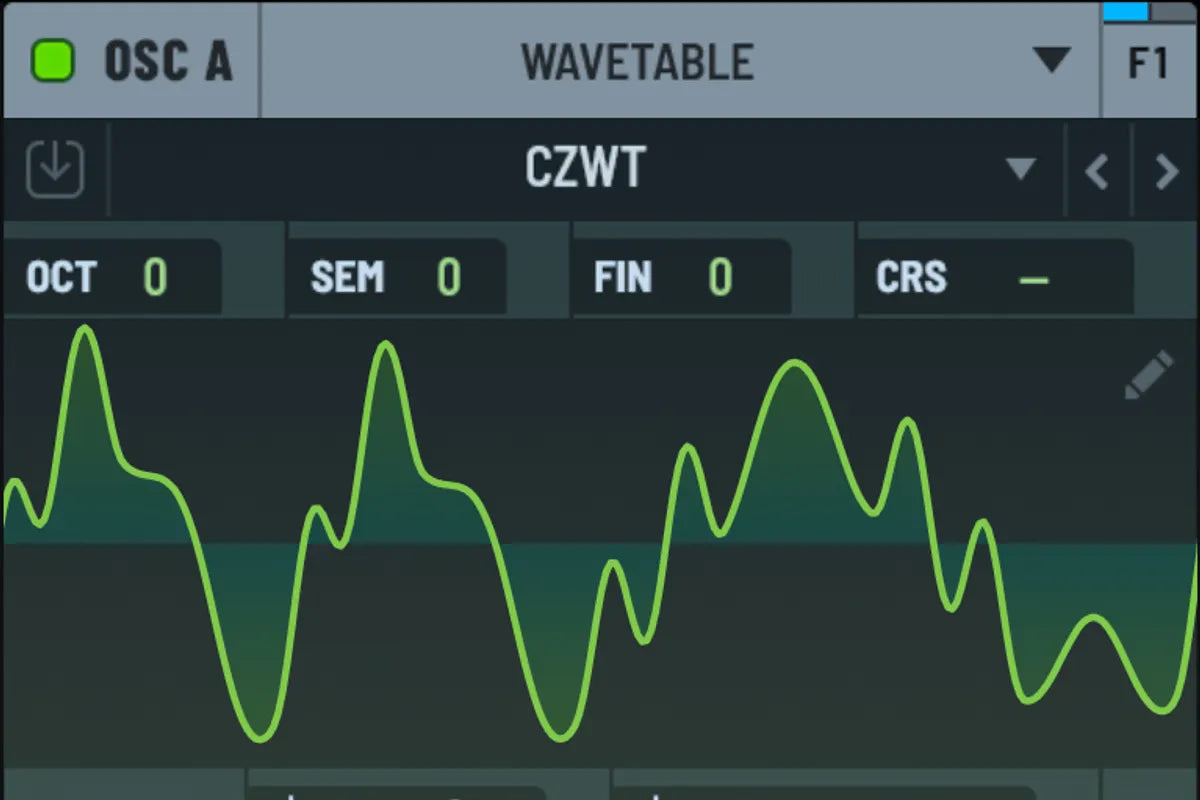
The CZ101 wavetable loaded into Serum 2's Oscillator A. That irregular green curve is the fingerprint we extracted — the oscilloscope shape of the original hardware.

Serum 2's wavetable editor showing the CZWT loaded across multiple frames. You can see how each frame is subtly different, that variation across the frames is what gives the wavetable its movement and character.
Selecting which cycles to keep is where the real craft lives. Early on, I built a wavetable with frames that were nearly identical all the way through — essentially identical cycles that added nothing. You have to learn to hear and see the interesting moments: where the phase relationship between the oscillators creates something distinctive. It takes time to develop that sense. There is no shortcut for it.
Using CZ101 Wavetables in Serum 2: What Becomes Possible
Once you have that wavetable loaded, Serum 2 is where things get interesting.
You can load two or three versions of the wavetable across different oscillators, tune them to different intervals, an octave down, a fifth, a fourth and a third for that thick, slightly queasy rave chord, and then start using FM synthesis between them. Oscillator B frequency-modulating Oscillator A. Oscillator C feeding into the chain. LFOs mapped to wavetable position so the sound morphs rhythmically.

Serum 2's wavetable import panel — the FFT analysis options here determine how Serum interprets the cycles when you bring in your audio. These settings matter, and the right choice depends on what you're trying to capture.
Serum changed synthesiser design when it arrived, and the reason is simply this: you can attach anything to anything. Before Serum, even sophisticated digital synths gave you a handful of modulation routing options. Serum gave you essentially unlimited routing. LFO to wavetable position. Envelope to FM amount. One oscillator modulating another. Effect parameters mapped back into the modulation matrix. It is the closest software has come to the architecture of those enormous modular synthesisers, the ones with hundreds of patch cables where anything can talk to anything. Ableton have since built their own Wavetable device into the suite, and it is capable, but Serum has four oscillators, multiple filters, and a modulation depth that Ableton's version does not match.
Wavetable vs Multi-Sample: Knowing Which to Reach For
There is a question worth addressing directly: if you want the authentic CZ101 sound, why not just use a multi-sampled version?
The honest answer is that it depends what you are trying to do.
A multi-sample, properly recorded across every note and velocity, which is exactly what we do with our hardware releases, gives you the actual sound. The real thing. If what you want is the emotional impact of that specific organ sound the way it appeared on those early 1990s records, with all its character intact, that is your answer.
A wavetable gives you the essence of the sound, but with the doors thrown open for transformation. You get that CZ101 character as a starting point, and then Serum's modulation architecture becomes your instrument. You can take it places the original hardware never could. You can make it contemporary. You can make it yours.
Neither approach is better. They solve different problems. Know what you are after before you reach for a tool.
Why Hardware Wavetables Sound Different to Digital Synthesis
I think about the CZ101 and tracks like those from Two Bad Mice or Pizzaman, and what strikes me is not the technical story, it is the human one. People made extraordinary music with a budget synthesiser because they understood what they were hearing and had the creativity to use it. The limitation became the sound. The sound became the culture.
Wavetable synthesis is one of the tools that lets us carry that forward. Not to reproduce the past, but to understand the fingerprint it left, and decide what to do with it next.
We are working on something that takes this further. More on that soon.