
Shape Transients and Add Saturation | Saturator Pro Ableton

Max For Live Audio Device

Getting transient shaping and harmonic saturation right in Ableton typically means reaching for two separate plugins, routing between them, and toggling between windows to compare results.

By the time you’ve set both up, you’ve lost the momentum you were trying to protect. Saturator Pro is a single Max for Live device that chains a precision transient shaper directly into a six-curve waveshaper, shape the attack first, then drive it through whichever saturation character suits the source, all with a real-time transfer function display showing exactly what’s happening to your signal.


Sale price£8.00 GBP

Professional Max for Live Design

All devices built with optimised CPU performance, bulletproof stability, and intuitive interfaces tested by working producers for reliable session performance.

Seamless Ableton Integration

Every device integrates natively into Ableton Live with full automation support, preset management, and zero plugin-bridging latency for frictionless workflow.

Clear Commercial Licensing

All Max for Live devices supplied with straightforward commercial licenses. Use in your productions with complete confidence.

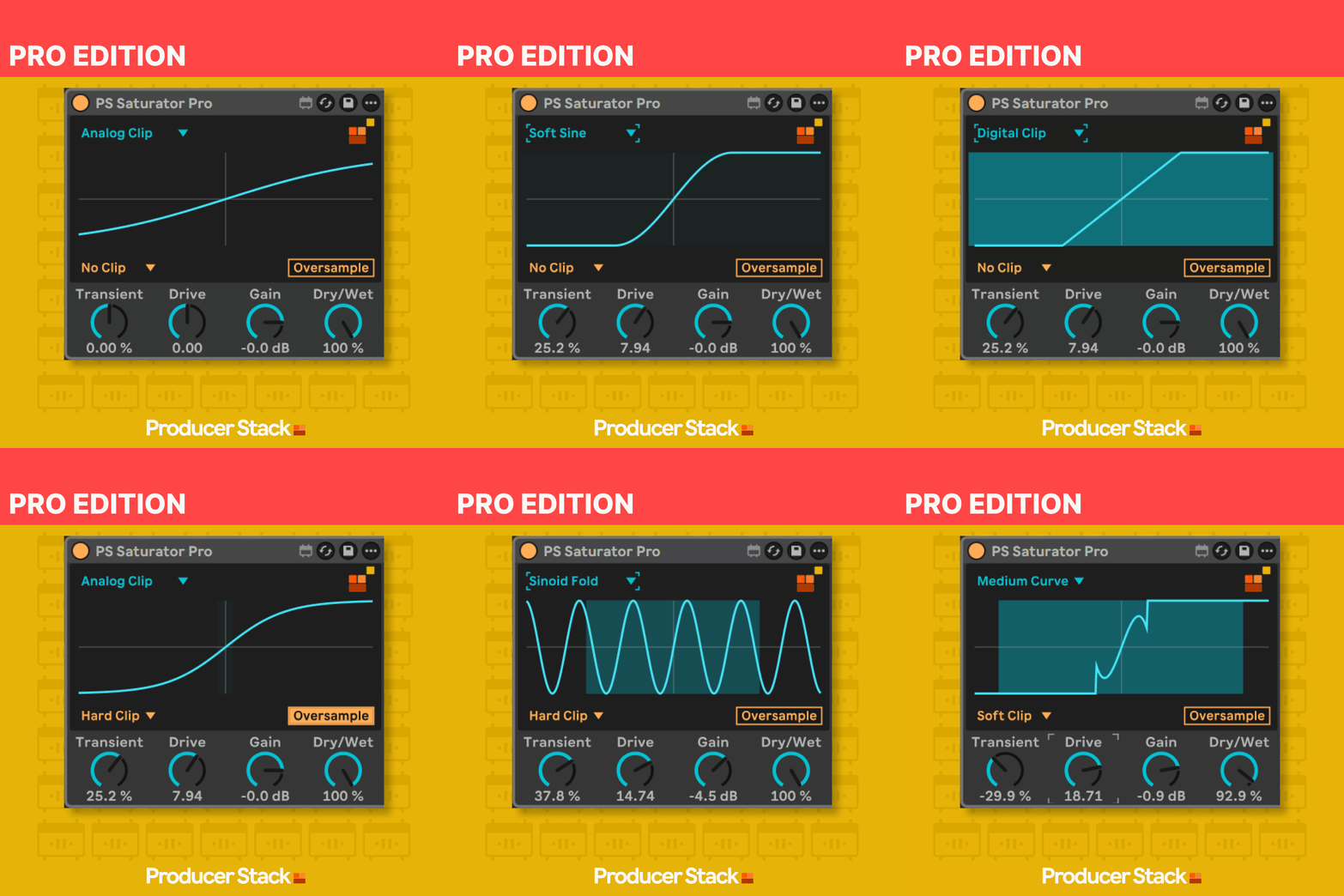
Animation of PS Saturator Pro - A Max for Live Device from Producersatck.com.
Audio processing software interface with a curve graph and control knobs on a dark background

What Saturator Pro Does

Saturator Pro uses a two-stage processing chain built on Ableton’s own DSP algorithms. The first stage — abl.dsp.transientdesign~ , gives you a single dial that ranges from attack-boosting at positive values to sustain-softening at negative values, with no pumping or artefacts at either extreme.

That transient-shaped signal feeds directly into abl.dsp.saturator~, where six distinct waveshaping curves determine the harmonic character: Analogue Clip for transparent tape-style warmth, Soft Sine for gentle thickening, Medium and Hard Curve for progressive harmonic density, Digital Clip for hard-edged modern distortion, and Sinoid Fold for experimental wavefolding.

A JavaScript-powered real-time display shows the exact transfer function curve as you adjust drive and mode, so you’re making informed decisions rather than guessing by ear. Integrated dry/wet crossfade gives you parallel processing without additional routing. Optional 2× oversampling maintains high-frequency clarity at extreme drive settings.

Why This Matters

Every Max for Live device we make follows one principle:

Remove friction, don't add features.

This tool works the way Ableton would have done it if they'd thought of it.

No flashy graphics.
No subscription.
Just a problem solved.
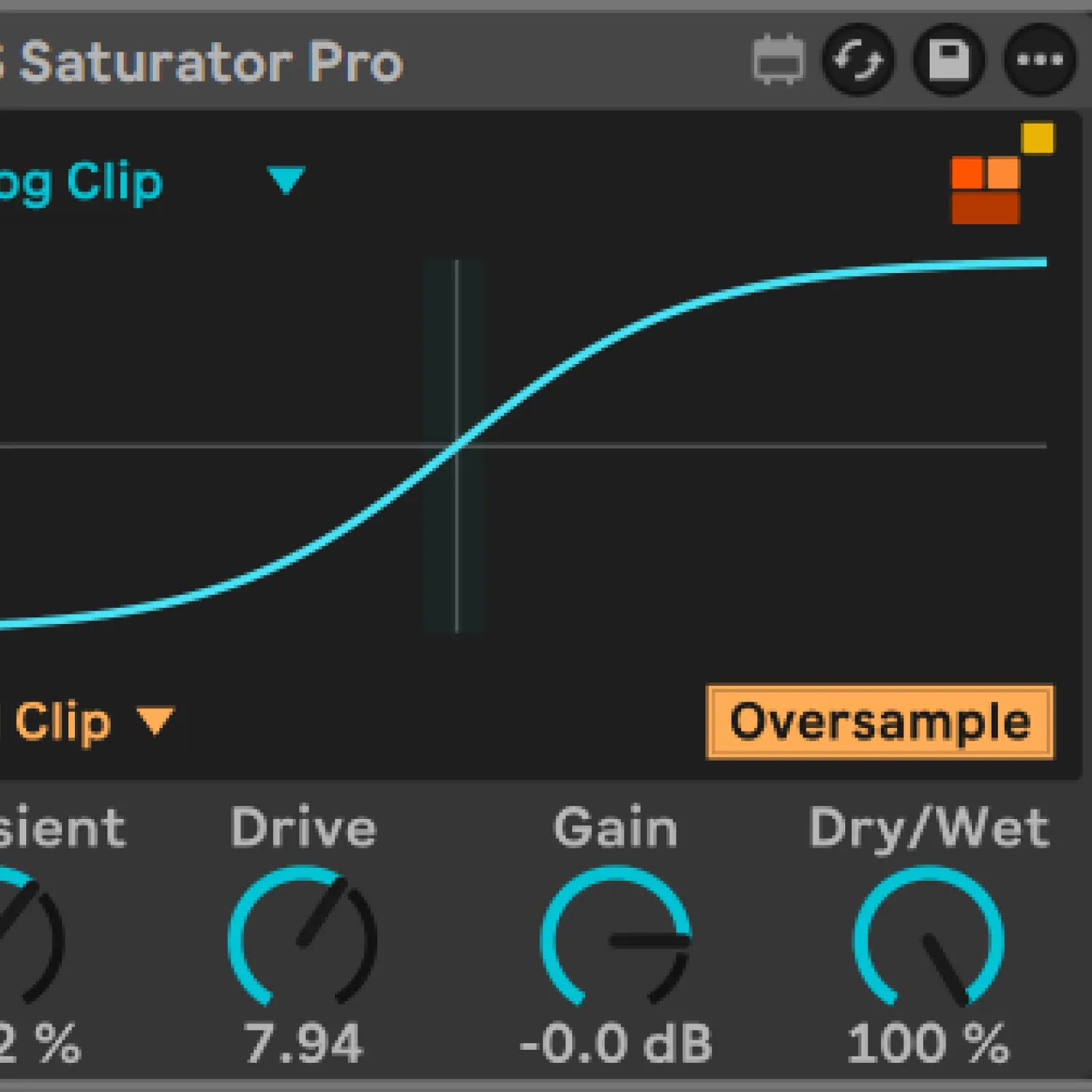
Saturator Pro showing six saturation curve options with real-time transfer function display and drive control in Ableton

Saturator Pro — Use Cases

  • Tightening bass transients before saturation so the fundamental frequency punches through without excessive low-end buildup, the transient stage handles the dynamics, the waveshaper adds the harmonic content
  • Adding tube-style warmth to lead synths in tech house or deep house using Analogue Clip with light drive and a moderate attack boost
  • Designing aggressive bass tones where Hard Curve or Digital Clip introduces controlled harmonic distortion that cuts through the mix without requiring compensatory EQ
  • Treating vocal presence — softening the attack to remove harsh consonants, then adding subtle Soft Sine saturation to thicken the body without increasing peak level
  • Experimental sound design using Sinoid Fold for wavefolding that turns simple waveforms into complex timbres without needing dedicated hardware

PS Saturator Pro: Max for Live transient shaper and saturator with six waveshaping curves for Ableton Live

Compatibility, Ableton Live & Max for Live

  • Max for Live 9.0.9
  • macOS 10.13 or higher / Windows 10 or higher
  • Pro edition only, single edition, no Standard tier

Ableton Live 12.0.5 or higher (Suite, or Standard with Max for Live purchased separately)

Saturator Pro | Frequently Asked Questions