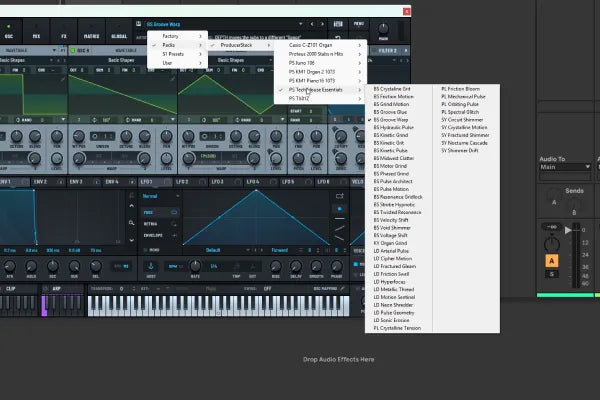
Open most preset packs and what you are really getting is a pile of starting points. Raw oscillators with a filter over them, a sound that is halfway to something, and the unspoken assumption that you will do the rest. There is a place for that. But it is not what we set out to make with Tech House Essentials, and after thirty years of building sounds, I have come to think the starting-point pack is close to the least useful thing you can hand a busy producer.
A preset should be a finished instrument. Something you can drop into a track and play, that already sits in a mix, already moves, already has a point of view. Getting a sound to that state is the actual work, and it is work that never shows up in a feature list. So let me tell you what is genuinely inside these forty presets, because it is not the thing most packs talk about.

A preset is sound design, not an oscillator
The value in a good preset is everything that happens after the raw sound. It is the filter movement that makes a stab breathe. It is the saturation and EQ sitting in exactly the right place so the sound already fits a tech house mix before you touch it. It is the modulation routing, the LFOs and envelopes wired to the parameters that actually matter, so the patch is alive rather than static. And it is the effect chain built into the preset, the delay, the reverb, the drive, balanced so the sound arrives produced rather than raw.
That is the part that takes the experience. Anyone can load an oscillator. Knowing which three parameters to put under one envelope so a bass develops across a bar, or how much of which saturation lets a lead cut on a club system without turning harsh, is the difference between thirty years of doing this and a clever afternoon. Every one of these forty presets has that work baked in. They are not starting points. They are finished sounds you can bend.
The Flex macro, and why it is the one to learn
The part I am most pleased with is the Flex macro, and if you take only one thing from this pack, make it this.
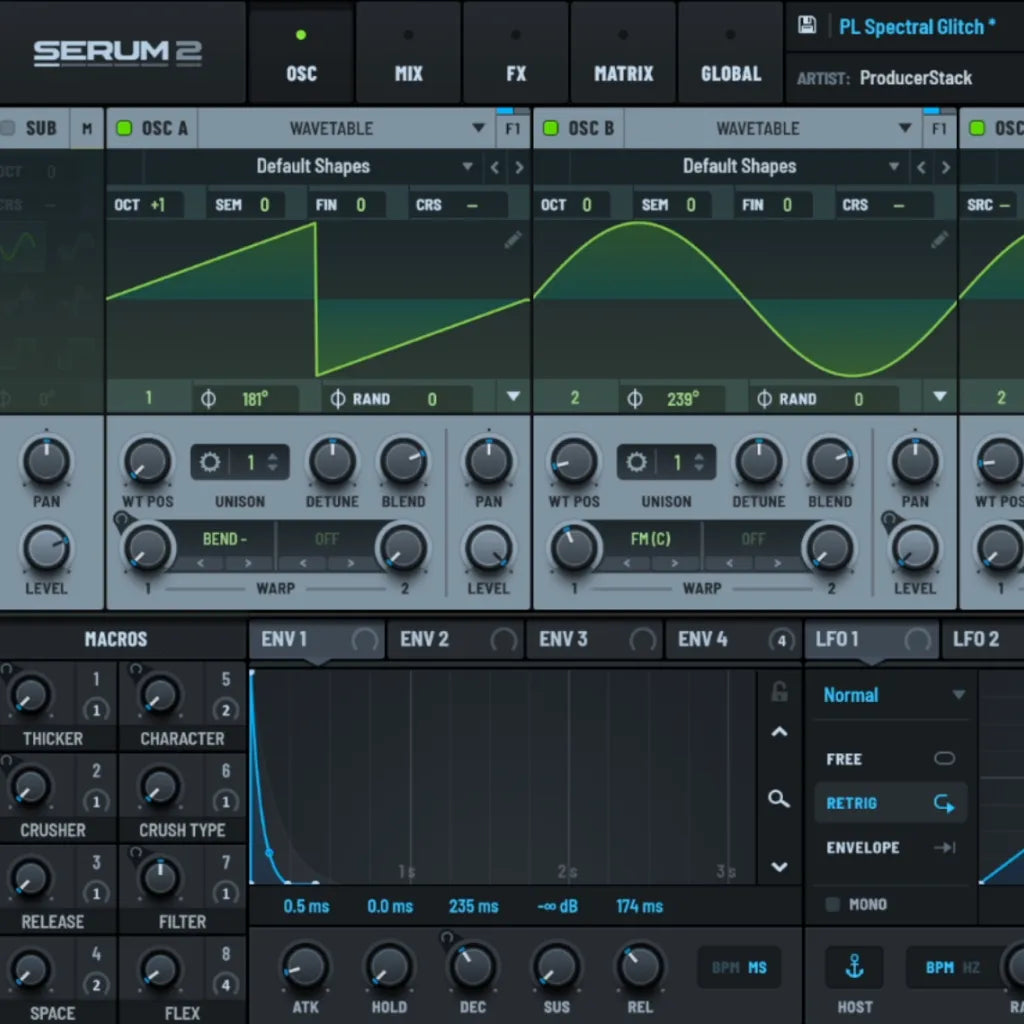
Every preset has the usual eight macros for quick shaping. The Flex macro is different. It is a macro of macros: one control mapped to an envelope, and that envelope drives the other macros underneath it. Turn the single knob and the whole patch reshapes at once, several parameters moving together in a way I have set up to stay musical across the entire sweep. You do not land on a broken sound at any point on the dial. You land on a different, usable one, fast.

What that gives you in practice is speed at the exact moment speed matters. You have a sound that is close, the idea is hot in your head, and instead of diving into four parameters and going cold, you ride one control and the patch moves with you. Use it as a performance control while you write and it will suggest variations you would never have programmed by hand. That is the whole point. The gap between an idea and a sound is where most ideas die, and the Flex macro closes it.
Where the wavetables come in
Now the wavetables, because they matter but they are not the headline. Fourteen of the forty presets are built on custom wavetables rather than Serum's stock tables. That is deliberate. A custom table gives a sound a character the factory set, used by everyone, simply cannot, and where a preset needed that edge, it got one. The other twenty-six use Serum's own engine, shaped by the same design work. The wavetable is a tool, used where it earns its place, not a gimmick stamped across the whole pack.
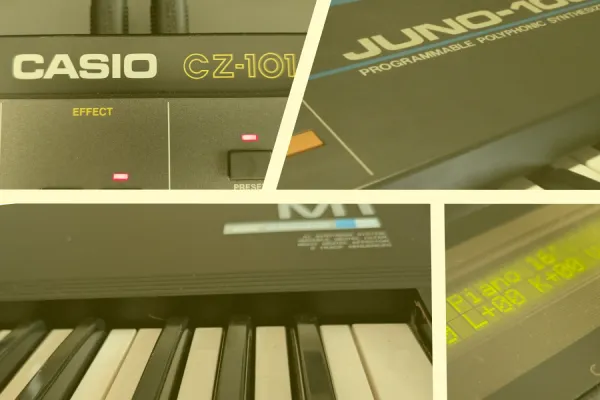
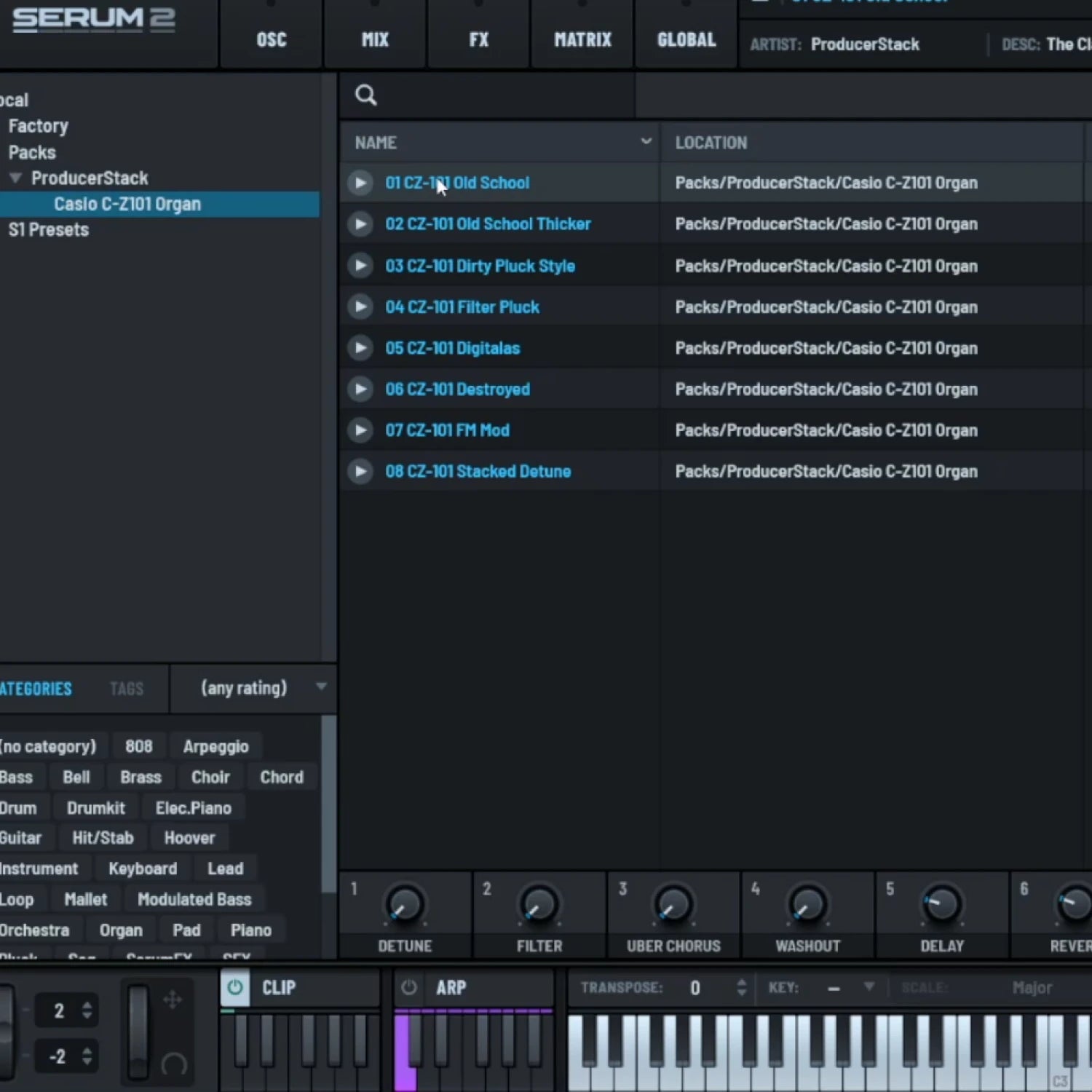
Here is the part worth knowing. Those custom wavetables are not conjured from nothing. Several are drawn from the same heritage-hardware captures behind our other releases, the phase-distortion organ of the Casio CZ-101 and the analogue warmth of the Roland Juno-106. So a few of these modern tech house sounds carry real vintage DNA underneath the design. If that interests you, and you would rather have the raw machines themselves to build your own sounds, those two packs are where the wavetables came from. And if you just want to understand what a wavetable actually is and why a custom one is worth the effort, the piece on wavetables goes into it.
How to actually use the pack
Treat these as instruments, not as raw material. Load one, play it in your track, and the odds are it already sits right, because the production work is done. Then reach for the Flex macro before you go digging, because nine times out of ten it gets you where you are going faster than tweaking by hand.
When you do want to go deeper, the chains and the modulation are all there to adjust, not locked away. Pull the reverb back, push the drive, remap a macro to taste. What you are starting from is a strong, finished state built by someone who has made a lot of records, and a finished state you can still take anywhere.
Where the pack fits
Tech House Essentials is forty Serum 2 presets built as finished sounds, with the macro mappings, effect chains and modulation already done, fourteen of them on custom wavetables drawn in part from our heritage hardware, and every one wired with the Flex macro so you can move it somewhere new in a single gesture. It is the sound design that takes years, handed over ready to play.