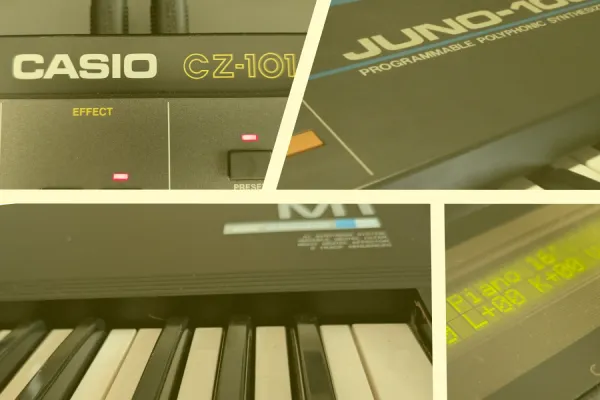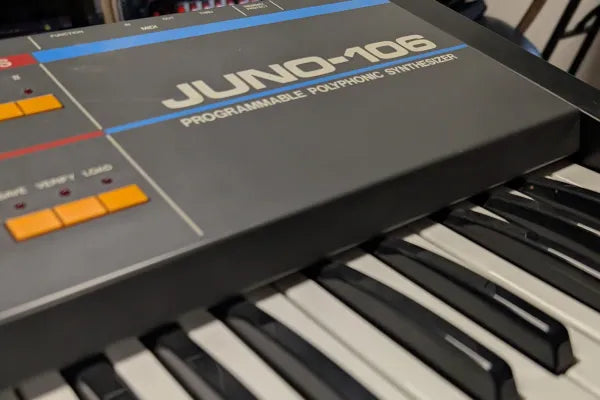
Ask a roomful of producers to name the greatest synthesiser ever made and nobody says the Roland Juno-106. They will reach for a Minimoog, a Prophet, a Jupiter-8, the expensive, revered machines. The Juno-106 was none of those things. It was relatively cheap, its chorus circuit was famously noisy, and it was built to be an affordable polysynth for people who could not stretch to the flagship. And it ended up on more house records than almost anything else.
That is not an accident, and it is not despite those limitations. It is because of them. After years of sampling vintage hardware, the Juno-106 taught me something that the famous synths never did: in dance music, the sound that matters is rarely the best sound. It is the familiar one.
Cheap, accessible, and everywhere
When Roland released the Juno-106 in 1984, it did something quietly radical. It put a warm, genuinely good-sounding analogue polysynth within reach of ordinary musicians and bedroom producers. You did not need a record deal to own one. That accessibility is the whole story.

Because so many people could afford it, so many people used it. And because so many people used it, its sound got woven into the fabric of an entire era of music. The same pads, the same bass, the same chorus-soaked warmth turning up on record after record, until that texture stopped sounding like a particular synth and started sounding like the genre itself.
The expensive synths have a different history. They appear on a handful of landmark records made by people who could afford them. The Juno-106 appears on hundreds, made by everyone, and that ubiquity is a kind of power the flagship machines never had.
Why familiarity carries weight
Here is the part that gets dismissed and should not be. People bang on about the Juno chorus as if it is just a noisy old circuit, and yes, it hisses. But that chorus is wicked, and the reason it lands is not purely sonic. It is emotional. When a listener hears that sound, they are not hearing a Roland Juno-106. They are hearing every record that ever used it, the clubs, the radio, the summers attached to those records. The sound carries all of that with it, whether the listener knows the name of the synth or not.
That is the thing software emulation often misses by aiming at the wrong target. The goal was never to model a perfect synth. The Juno was not perfect. The goal is to capture the exact texture that became familiar, the slightly noisy, warm, instantly recognisable one, because the familiarity is where the emotional weight lives. Get a clinically accurate version of the circuit and you can still miss the point. Get the texture that people actually remember and you have the sound that does the work.
What you actually reach a Juno for
In house music, the Juno-106 does two jobs better than almost anything, and both are about feel rather than flash.
The pads are the obvious one. Lush, warm, wide, sitting behind a track and filling the space without demanding attention, the chorus giving them that gentle movement that keeps a held chord alive. A huge amount of what we think of as the warmth of classic house is a Juno pad doing quiet, essential work in the background.
The bass is the underrated one. Round, simple, solid, it locks with a kick and holds the bottom of a track without any fuss. It is not a sound that shows off. It is a sound that works, every time, which is exactly why it got used so much.
Neither of these is trying to be the centre of attention, and that is the point. The Juno-106 is a foundational sound. It is the thing the rest of the track stands on.
Using the sound today
If you are writing house, the move is not to treat a Juno sound as a feature. It is to use it as the warm bed that everything else sits on. Lay a pad underneath your chords and let it do the emotional lifting while your lead or stab carries the melody on top. Use the bass as an anchor, simple and steady, and resist the urge to over-design it. The Juno worked because it stayed out of the way, and that restraint is half the sound.

And lean into the texture rather than cleaning it up. The slight noise, the chorus movement, the imperfection, that is the character that triggers recognition. Polish it all away and you have a generic warm synth. Keep it and you have the sound people already feel something about.
Where the pack fits
The Roland Juno 106 pack captures the classic pad and bass sounds of the 106, multi-sampled for Serum 2, with the texture that made the original familiar kept intact rather than cleaned out. If you want to understand why multi-sampling the real hardware gets you closer than modelling it, the piece on why multi-sampling matters explains the thinking. And if the Juno is one of several classic sounds you keep reaching for, it also lives inside the Heritage Sounds Bundle alongside the rest of the machines that built this music.